While there's an abundance of commissioners appointed to combat any form of antisemitism, facts on the ground show they are not actually doing much
The proliferation of commissioners tasked with fighting antisemitism across the European Union, particularly in Germany, recalls the biting sarcasm of the German-Jewish journalist Kurt Tucholsky in 1931: "A German's fate: to queue at a counter. A German's dream: to sit behind a counter."
Tucholsky’s wit has not lost its relevance in 2023. There is a kind of expectation among European Jews and others, who are lining up at the doors of scores of antisemitism commissioners in Europe and Germany, that something will be done.
4 View gallery
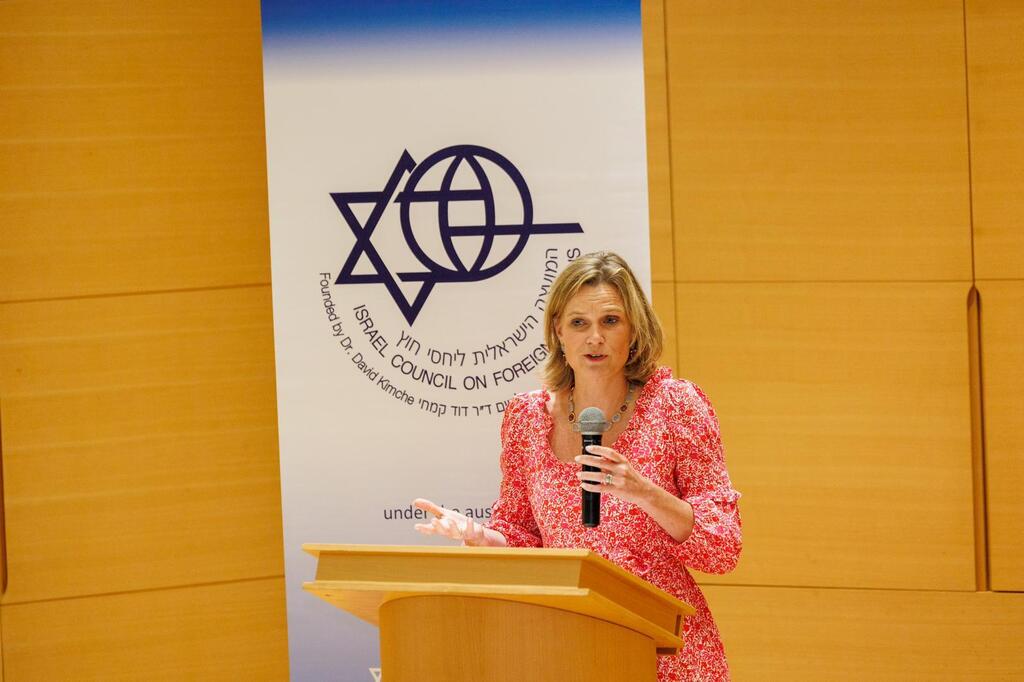
EU Envoy for Combating Antisemitism Katharina Von Schnurbein
(Noam Feiner/ICFR)
And there is no shortage of people seeking to serve as a commissioner, an office that imparts a vanity title, creates a sense of being on the side of the angels, and allows a generous budget for travel to conferences and schmooze events.
Nearly all 16 German states have commissioners assigned to combat antisemitism. The city-state of Berlin has five. In North Rhine-Westphalia there are 22 commissioners, and a federal commissioner exists along with an EU counterpart.
The problem with the cottage industry of bureaucratic positions with titles such as the “federal government commissioner for Jewish life in Germany and the fight against antisemitism” for Felix Klein in Germany and “European Commission coordinator on combating antisemitism” for Katharina von Schnurbein is that the state apparatus has established yet another layer of bureaucracy that is not in the business of tackling antisemitism as a counter-terrorism project.
Making matters worse, some of the commissioners are stoking Jew-hatred.
Natan Sharansky, who serves as the chairman of the Institute for the Study of Global Antisemitism and Research and who developed the modern definition of antisemitism, recently termed a tweet by the commissioner in the state of Baden-Württemberg, Michael Blume, as antisemitic.
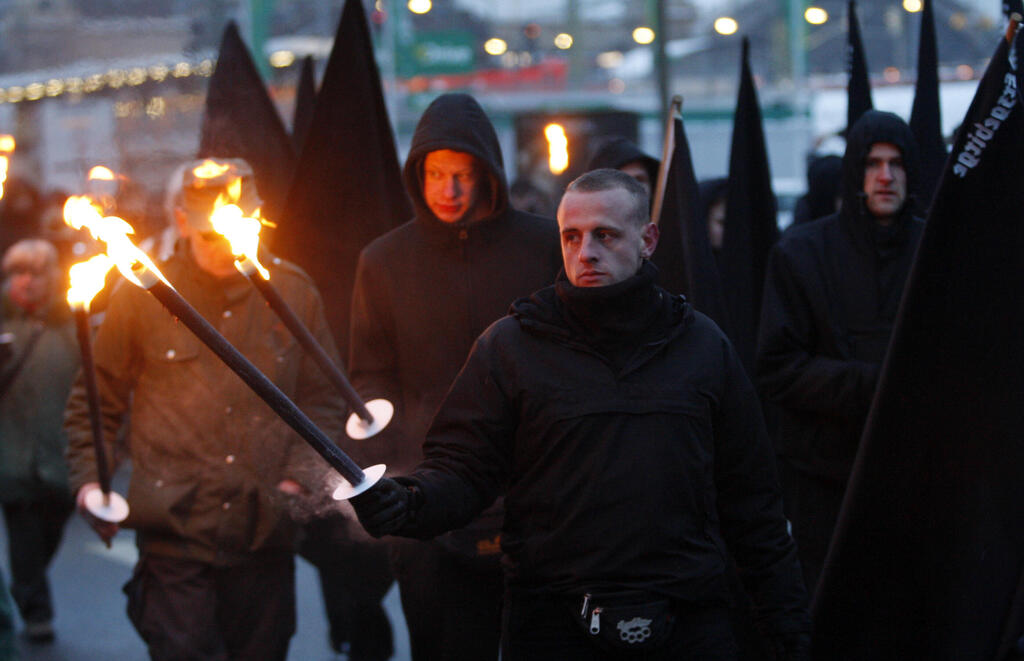
Far-right activists marching through Dresden, Germany
(Photo: Petr David Zusak / AP)
Sharansky, a former Soviet dissident and former Israeli government minister, said Blume’s tweet was antisemitic because “it demonizes our people and goes to classic antisemitic conspiracy theory. It is a legitimate question, why should German government pay him for fighting antisemitism.”
Blume suggested in his tweet that he is a victim of a nebulous group of Israelis known as “Team Jorge” who allegedly operate outside of Tel Aviv and might be involved in spreading disinformation about him. He provided no evidence.
Blume has a documented history of spreading anti-Jewish and anti-Israel conspiracy theories on social media. The Los Angeles-based Simon Wiesenthal Center cited Blume as part of the seventh worst outbreak of antisemitism in 2021.
Sadly, the examples of antisemitic and severely incompetent commissioners abound.

(Photo: Shutterstock)
The commissioner of the northern state of Schleswig-Holstein, Gerhard Ulrich, who served as a Protestant bishop for northern Germany, preached sermons laced with contemporary antisemitism. Ulrich sees the Jews as warmongers – in language that recalls the Hitler movement blaming Jews for a global war: “Therefore we cannot accept it when a modern state invokes this God and his promises when war is waged,” he declared.
Ulrich reduced the cause of conflict and suffering in the Middle East to one country: “The name ‘Israel’ is burdened with the horror and misery of this Middle East war.” He also likened Israel’s security barrier, which has prevented Palestinian terrorism, to the former East German state’s Berlin Wall.
Commissioner von Schnurbein has been in office since 2015 and has not uttered a single public remark about the pressing need for the EU to outlaw the entirety of the genocidally antisemitic terrorist organizations Hezbollah and the Iranian Islamic Revolutionary Guard Corps (IRGC). In 2019, when asked whether the EU should ban Hezbollah, von Schnurbein said, “My responsibilities concern EU-internal policies in the fight against antisemitism.”
A bizarre response in light of the fact that Hezbollah carried out a terror bombing in an EU-member state, Bulgaria, in 2012. Five Israeli Jews and their Bulgarian Muslim bus driver were murdered. Schnurbein continued to stay silent this year about terror proscriptions for Hezbollah, the IRGC, and the Palestinian NGO Samidioun. Lethal antisemitism carried out by jihadi terrorist movements is not front-and-center in the EU’s thinking.
In late 2022, German state security sources accused the IRGC of contracting terrorism against synagogues in the state of North Rhine-Westphalia and spying on the president of the Central Council of Jews in Germany. According to a report by ARD television’s political magazine Kontraste, security sources believe Ramin Y., a German-Iranian, was behind the attacks. “We’re talking about state terrorism here,” one investigator told Kontraste.
Klein, the German federal commissioner, published a report on behalf of the German Interior Minister Nancy Faeser titled “National Strategy against Antisemitism and for Jewish Life.” It failed to mention the IRGC, Hezbollah and radical Islamism. Both Klein and Schnurbein hailed the “National Strategy” report as a “milestone.”
Compounding the problem, Klein ignored the 2019 German court conviction of Pakistani citizen Mustufa Haidar Syed-Naqfi, whom the IRGC paid to conduct surveillance on European Jews and Israeli institutions. According to German authorities, Syed-Naqfi’s actions were “a clear indication of a [planned] assassination attempt.”
It is unclear why Klein refuses to confront Iranian regime-sponsored lethal antisemitism in Germany. For example, he carved out the time during the Trump administration’s tenure in office to slam antisemitism in the United States. A possible explanation for Klein’s silence: Germany’s government is deeply wedded to the flawed Iran nuclear deal, the Joint Comprehensive Plan of Action, and probably does not want Klein to toss a wrench in the efforts to revive the agreement.

The star of David on a fence
(Photo: Shutterstock)
Former U.S. Secretary of State Mike Pompeo declared the Islamic Republic of Iran to be the world’s top state sponsor of antisemitism. The US government under both Democratic and Republican administrations has designated Iran’s theocratic state as the world’s worst state sponsor of terrorism.
One can only hope that the current United States special envoy to monitor and combat antisemitism, Deborah E. Lipstadt, will move her colleagues across the Atlantic to recommend a terror proscription for the IRGC and Hezbollah.
As a general rule, it is not a good idea for Jewish communities to completely outsource their security to bureaucrats. An innovative example of a private-public partnership is furnished by the Jewish community in the UK, which created the Community Security Trust to provide “safety, security and advice” to the country’s Jews. The CST is independent of the British government but works with law enforcement officials to prevent violent antisemitic attacks.
Sadly, German officials and the EU state apparatus will likely ignore calls to change their behavior. To return to Tucholsky: “Furthermore, here the one pointing out the filthiness is perceived as much more dangerous than the one producing the filth.”
https://www.ynetnews.com/article/byln5ffdh
-----------------------
This article would even be more powerful if this journalist, and this media, had, at any time, give a hand to my work which does not seem to be against any fight...